Ads 468x60px

Thursday, April 9, 2009

Quinoa Recipe: Stuffed Portobello Mushrooms with Pine Nuts and Raisins

Quinoa stuffed mushrooms are gluten free and vegan
Quinoa stuffed portobello mushrooms are a lovely vegan nosh.


The stars are tuning their alignment in our favor. After eighteen months on the market (and more than once price reduction along the way) there are rumblings of a house sale. Negotiations are afoot. We are walking on Easter egg shells through the weekend. Monday will bring us definitive news. Send kind and generous thoughts to our buyer. Wish him luck with his bank.

We've been preparing for good news, sorting through books both old and new. Stripping away much of what we've accumulated since our last move. Lugging movies and art books and cookbooks off in recycled Whole Foods bags to the used book store in Santa Fe. Those things we carry.

Trading media for food.

We took the cash and bought wine, gluten-free flours, olive oil and boxes of tea. Not enough to last through May. On purpose.

Read more + get the recipe >>

Wednesday, April 8, 2009

Modern Diet-Health Epidemiology: a Self-Fulfilling Prophecy? Part I

Epidemiology is the study of population statistics to learn about health. It can provide simple information such as the prevalence of hepatitis C in a particular region, or it can provide more complex information such as the association between dietary patterns and gout. It has brought us many great things, from its roots in understanding the transmission of communicable diseases, to the identification of smoking as the probable cause of lung cancer.

Observational studies are a mainstay of epidemiology. In observational studies, investigators gather data passively rather than manipulating variables. For example, if you want to know if people who wear tight shoes develop bunions, you would find a group of people who wear tight shoes and one that doesn't. You would try your best to make sure the groups are the same in every way besides shoe tightness: age, gender, weight, etc. Then you would follow them for 10 years to see how many people in each group develop bunions. You would then know whether or not wearing tight shoes is associated with bunions.

Observational data can never tell us that one thing caused another, only that the two are associated. The tight shoes may not have caused the bunions; they may simply have been associated with a third factor that was the true cause. For example, maybe people who wear tight shoes also tend to eat corn flakes, and corn flakes are the real cause of bunions. Or perhaps bunions actually cause people to wear tight shoes, rather than the reverse. Observational data can't resolve these questions definitively.

To establish causality, you have to do a controlled trial. In the case of our example, we would select 2,000 people and assign them randomly to two groups of 1,000. One group would wear tight shoes while the other would wear roomy shoes. After 10 years, we would see how many people developed bunions in each group. If the tight shoe group had more bunions, we could rightly say that tight shoes cause bunions. The reason this works is the randomization process (ideally) eliminates all differences between the groups except for the one you're trying to study. You should have the same number of corn flake eaters in each group if the randomization process worked correctly.

A less convincing but still worthwhile alternative would be to put tight and loose shoes on mice to see if they develop bunions. That's what researchers did in the case of the tobacco-lung cancer link. Controlled studies in animals reinforced the strong suggestion from epidemiological studies that smoking increases the risk of lung cancer.

Finally, another factor in determining the likelihood of associations representing causation is plausibility. In other words, can you imagine a way in which one factor might cause another or is the idea ridiculous? For example, did you know that shaving infrequently is associated with a 30% increase in cardiovascular mortality and a 68% increase in stroke incidence in British men? That's a better association than you get with some blood lipid markers and most dietary factors! It turns out:
The one fifth (n = 521, 21.4%) of men who shaved less frequently than daily were shorter, were less likely to be married, had a lower frequency of orgasm, and were more likely to smoke, to have angina, and to work in manual occupations than other men.
So what actually caused the increase in disease incidence? That's where plausibility comes in. I think we can rule out a direct effect of shaving on heart attacks and stroke. The authors agree:
The association between infrequent shaving and all-cause and cardiovascular disease mortality is probably due to confounding by smoking and social factors, but a small hormonal effect may exist. The relation with stroke events remains unexplained by smoking or social factors.
In other words, they don't believe shaving influences heart attack and stroke directly, but none of the factors they measured explain the association. This implies that there are other factors they didn't measure that are the real cause of the increase. This is a critical point! You can't determine the impact of factors you didn't measure! And you can't measure everything. You just measure the factors you think are most likely to be important and hope the data make sense.

This leads us to another important point. Investigators can use math to estimate the relative contribution of different factors to an association. For example, imagine the real cause of the increased stroke incidence in the example above was donut intake, and it just so happens that donut lovers also tend to shave less often. Now imagine the investigators measured donut intake. They can then mathematically adjust the association between shaving and stroke to subtract out the contribution of donuts. If no association remains, then this suggests (but does not prove) that the association between shaving and stroke was entirely due to shaving's association with donuts. But the more math you apply, the further you get from the original data. Complex mathematical manipulation of observational data requires certain assumptions, and while it is useful for extracting more information from the dataset, it should be viewed with caution in my opinion.

Of course, you can't adjust for things you didn't measure, as the study I cited above demonstrates. If factors you didn't measure are influencing your association, you may be left thinking you're looking at a causal relationship when in fact your association is just a proxy for something else. This is a major pitfall when you're doing studies in the diet-health field, because so many lifestyle factors travel together. For example, shaving less travels with being unmarried and smoking more. Judging by the pattern, it also probably associates with lower income, a poorer diet, less frequent doctor visits, and many other potentially negative things.

If the investigators had been dense, they may have decided that shaving frequently actually prevents stroke, simply because none of the other factors they measured could account for the association. Then they would be puzzled when controlled trials show that shaving doesn't actually influence the risk of stroke, and shaving mice doesn't either. They would have to admit at that point that they had been tricked by a spurious association. Or stubbornly cling to their theory and defend it with tortuous logic and by selectively citing the evidence. This happens sometimes.

These are the pitfalls we have to keep in mind when interpreting epidemiology, especially as it pertains to something as complex as the relationship between diet and health. In the next post, I'll get to the meat of my argument: that modern diet-health epidemiology may in some cases be a self-fulfilling prophecy.

Monday, April 6, 2009

Dental Anecdotes

Here are a few anecdotes gleaned from past comments that describe improvements in oral health due to a change in diet. Please feel free to add your own (positive or negative) experience to the comments. I may add it to the post.

Stan: My teeth stopped decaying and some breakage (broken tooth due to mechanical damage, 5 years ago) begun sealing itself with new enamel on my high animal fat, low carb diet of the last 10 years. I still have all my teeth including wisdom teeth. My teeth no longer develop plaque/scale and thus no need to descale, and I no longer develop cold sores on my gums. I haven't been to a dentist since 1999 (I am 53). [From another comment] I can fully confirm the astounding effect of a diet very high in animal produce and low in plants, on my teeth. My tooth decay has totally stopped! I wrote about that before but it is worth repeating: - my teeth would not decay even if mechanically damaged, broken in half etc. The broken exposed parts of a tooth, even if the core is open, just seals itself over time.

Dave: Our family has had similar experiences. In particular, my daughter had a poorly formed molar (she was a spring baby, before we started Vitamin D, hmmmm). The tooth had quite a large crater in it. I put her on D3 and cod liver oil/butter oil. We finally got a dentist she'd cooperate with enough for X-rays. The result was exactly as described above: a thick layer of dentin had formed. The dentist was thoroughly puzzled, which I enjoyed immensely :-)

Arnoud: For years my dentist has been insisting on more frequent and more aggressive cleaning techniques.... to no avail. Last year I started Vitamin D supplementation, and a more Paleo style of diet, and the 'chronic' inflammation of my gums resolved themselves within days, literally. My dentist claims it is a coincidence. I think not!

Martin: Once I changed my diet to one close to what is listed in this entry, and added a vitamin D3 supplement, my dental health greatly improved. No more cavities, and beyond that, no more rapid build-up of dental plaque. To prevent gum problems, I used to have to get my teeth cleaned four times a year, now, once a year is enough, and it seems to me, even that might not be necessary.

Thresshold: I am a cavity-every-six-months person, who arrested decay for 3 years by going on a Protein Power-like diet. No limit on non-starchy veggies, lots of meat-- turkey, beef --lots of nuts, olive oil, egg a day. No grains. Very little fruit, no sugar. Plenty of supplemented vitamin A and D, E, C, Bs, some dolomite.

Jeff: I just had a dentist visit, first in almost 3 years. No cavities for the first time in a while. Your advice and a Paleo diet are the reason, in my mind.

Dr. Dan: Before paleo I had bleeding gums and sore teeth. Now that I have been on it I have not had them and my flatmate just commented how white my teeth are looking.

Cheeseslave: I have also eliminated cavities since I changed the way I eat. I avoid all phytic acid (I try to only eat sprouted bread or naturally fermented sourdough) and I soak or sprout all my grains, legumes, nuts and seeds. I also take cod liver oil, and eat a nutrient-dense diet consisting of mostly meat and dairy.

Dr. B. G.: Myself, I had periodontal disease (esp immed after pregnancy and lactation -- wonder W-H-Y ??!) however at the last check up -- I have no more pockets of '5' and am released to come in only 2x annually instead of all the extra (painful) de-planing and cleanings. This was improved by: vitamin A, vitamin D 5000 IU every am, high dose fish oil, flaxseed and egg yolks and saturated fats and some K2 supplements. [From another comment] I have to admit -- my dental problems reversed prior to total Paleo eating (eg, wheat-free). On vitamin D and fish oil alone my cavities sealed. In fact I had gone back to see the DDS but he couldn't find one tiny 'sticky' spot. When he decided to fill it irregardless (and I was an idiot to not walk out b/c who knew that cavities could heal/seal...on their own??), then I had to leave him. At that point, the dental hygienist had already let me return to a 'normal' insured 2 cleanings/yr schedule, instead of the $$ 4/year (where 2 were out-of-pocket). With going 100% wheat-free, vits ADEK and adding a little (fresh highquality) flaxseed oil, my gums are super healthy and no throbbing at all for the last 9mos!

Brock:
When I went to my dentist for the first time in a while last September I was told I had six cavities. My dentist told me to schedule to get them filled in, but I never did. I just had the intuitive feeling that the human body ought to be able to heal itself, and that for some reason my dentist just didn't know how. So, I started Googling. My search lead me here and to the Weston Price Foundation. I bought Dr. Price's book and changed by diet months ago. I eat mostly paleo but mainly just focus on avoiding wheat, corn, sugar and n6 fats. I supplement with Vitamins A, C, D, E and K2. Long story short, my six cavities have closed up and my teeth have noticeably improved in color and "feel". Swelling in my gums is down. I can often go for weeks now without brushing my teeth without any noticeable side effects. It's great.

Andrew S.:I had a lot of cavities growing up, and as a young adult. I started up a new company, didn't have health insurance, and didn't go to the dentist in a while -- and started eating whole, natural foods, with a bit of supplementation (mostly cod liver oil). I was surprised when I visited the dentist for the first time in years to not have any decay.

Robert Andrew Brown: I too have gone from regular cavities, indifferent gum health, sensitive teeth, and a host of dental work to prove it, to none since balancing the Omega 3s and 6s, and regular 'industrial' cod liver oil. Small carries that were sensitive and on the list for restorative work have re mineralised and skinned over but not refilled. I have only recently started seriously increasing vitamin D and reintroducing grass fed butter.

Wow

Last Thursday, the post "Reversing Tooth Decay" made it to the front page of Reddit, a news aggregator site. I ended up getting 46,429 hits that day, and another 8,646 the next day. I normally hover between 1,500 and 3,000.

It was a wild ride. I'd like to send out a big thanks to whoever posted the article to Reddit, and everyone who voted for it. I appreciate you helping to spread the message.

Saturday, April 4, 2009

Growing my food

After many years of saying that I would grow my own food I finally just got started on the garden and preparing it all. Because kids come over and for other reasons we made a couple garden boxes. Although there is no sheeting underneath it, it acts more as a barrier so that they don't get stamped on by people. So far in the first box that you can see has been done I have planted spinach and broccoli. I plan on having tomato plant, carrots, apple trees, herbs, I'll also have some sprouts growing by my window inside the house. I'm still looking at other things to grow of course but doing some research on it at the moment since I'm quite new to this. We have a fairly big garden so at least we are now putting the space to good use.

Here is the garden as of today;


I am planting in those two boxes, to the left of them where you can see the earth dug up. Also I have a little patch on the upper right too. We have more space behind where I was standing on the first picture, and we also have even more space to the right of where I was standing. At the moment I'm checking out how long each patch has in sunlight though first. I'm wanting at least 5-6 hours I think, preferably more.

I will keep you updated and add photos as I progress :)

A New Way to Soak Brown Rice

I've been looking for a way to prepare whole brown rice that increases its mineral availability without changing its texture. I've been re-reading some of the papers I've accumulated on grain processing and mineral availability, and I've found a simple way to do it.

In the 2008 paper "
Effects of soaking, germination and fermentation on phytic acid, total and in vitro soluble zinc in brown rice", Dr. Robert J. Hamer's group found that soaking alone didn't have much of an effect on phytic acid in brown rice. However, fermentation was highly effective at degrading it. What I didn't realize the first time I read the paper is that they fermented intact brown rice rather than grinding it. This wasn't clear from the description in the methods section but I confirmed it by e-mail with the lead author Dr. Jianfen Liang. He added that the procedure comes from a traditional Chinese recipe for rice noodles. The method they used is very simple:
  1. Soak brown rice in dechlorinated water for 24 hours at room temperature without changing the water. Reserve 10% of the soaking liquid (should keep for a long time in the fridge). Discard the rest of the soaking liquid; cook the rice in fresh water.
  2. The next time you make brown rice, use the same procedure as above, but add the soaking liquid you reserved from the last batch to the rest of the soaking water.
  3. Repeat the cycle. The process will gradually improve until 96% or more of the phytic acid is degraded at 24 hours.
This process probably depends on two factors: fermentation acidifies the soaking medium, which activates the phytase (phytic acid-degrading enzyme) already present in the rice; and it also cultivates microorganisms that produce their own phytase. I would guess the latter factor is the more important one, because brown rice doesn't contain much phytase.

You can probably use the same liquid to soak other grains.

Thursday, April 2, 2009

Gluten-Free Garlic and Sesame Crackers

Gluten-free crackers with garlic and sesame
Make your own gluten-free snack crackers- it's easy.

Crackers don't get enough credit. I guess they're not cute enough. Or sexy enough. No swirls of pastel icing. No confetti sprinkles. No tiny ribbons and bows. No Jackson Pollock drips of balsamic reduction or snow pea puree.

Just simple squares.

Ho-hum brown.

Crackers are the wallflowers at the food blogger's party. Too ordinary and unassuming to garner much attention. But there might be a few of you in the same boat I row upstream.

The snack deprived boat.

So this one's for you.

Folks who can consume gluten probably take their snacks for granted. After all, they can grab any bag of chips or cracker box off the shelf of any market or convenience store and motor on over to the cheese section without breaking a sweat. Snack attack solved. Please pass the Doritos.
But for those of us living gluten-free and casein-free- it ain't so easy. (And if you happen to have additional allergies- to sunflower oil or nuts or spices- you get one complicated serpentine quest for a safe little bite.)

At this writing, I can count on one hand the number of available chips or crackers I can eat. Safely. And for some mysterious reason that only the petulant Goddess of the Universe knows, that modest handful of snack options is never stocked. Anywhere.

I search in vain every weekly trip to Santa Fe for the one potato chip I can eat. Or a single non-GMO tortilla chip. Even those funny little white rice wafers play hard to get. New Mexico appears to be staunchly plain rice cracker free (I guess rice crackers don't like to flirt with guacamole and salsa).

Which explains why I bake my own snacks and crackers.

It's a pragmatic choice. I've made Pecan Crackers, and Savory Grain-Free Crackers (back when I didn't know I was allergic to Parmesan). I've made crispy sweet potato and gold potato chips.

But this week we found ourselves crackerless. So we baked up a new recipe on the spot. With garlic and sesame seeds. If you cannot eat sesame, darling, flax seeds or hemp seeds will work.
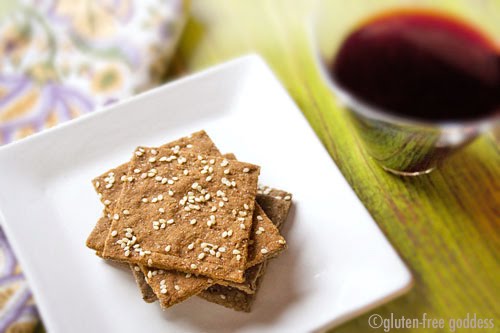

Gluten-free sesame crackers
Crisp and lovely gluten-free crackers.


Garlic and Sesame Gluten-Free Cracker Recipe

I ended up using a half cup of pecan meal in this recipe because nut meal adds to the taste and texture of gluten-free crackers. If pecans are a problem for you, almond meal will work. Or use a quarter cup of seeds, if you prefer (note that adding seeds into the dough may make the crackers less crisp).

Whisk together the dry ingredients:

1/2 cup sorghum flour
1/2 cup buckwheat flour
1/2 cup millet flour
1/2 cup pecan or almond meal
1/4 cup quinoa flour or brown rice flour
1 tablespoon potato starch
2 teaspoons cocoa powder
1 teaspoon baking soda
1 teaspoon sea salt
1 teaspoon garlic powder
1 teaspoon dried minced onion
1 teaspoon dried thyme or dried crushed rosemary
1 teaspoon xanthan gum

Stir in:

1/4 cup good olive oil
Ener-G Egg Replacer for 1 egg whisked with warm water
1/3 to 1/2 cup warm water, to start
1 tablespoon honey, raw agave or molasses

Instructions:

Stir the ingredients until a stiff dough forms- you'll need to press the dough out into a thin layer, so if it appears too dry, or it falls apart easily, add one tablespoon of warm water and mix; repeat until the dough is malleable but not too wet.

Divide the dough in half.

Preheat the oven to 375 degrees F. Line two baking sheets with parchment or a reusable Exopat.

Using oiled hands flatten and spread half the dough on the prepared baking sheet. Make as thin a layer as possible. Use the edge of a rubber spatula to straighten outside edges, if you like.

Score the flattened dough into cracker sized pieces. I used a pizza cutter to do this.

To bake you'll need:

Sea salt
Sesame seeds (or flax seeds, or hemp seeds)

Sprinkle the scored dough with salt and sesame seeds.

Bake in the center of a preheated oven for 15 to 20 minutes till firm and slightly crisp (they will crisp up more as they cool). I use an Exopat, so keep that in mind; they may cook faster without one. Keep an eye on them.

Remove and allow the crackers to cool on a rack.

We bag and freeze the cooled crackers. If you find they soften from humidity, reheat them on a baking sheet for a few minutes before serving.

Makes 36 crackers.


Sesame seeds add a nice touch.

Karina